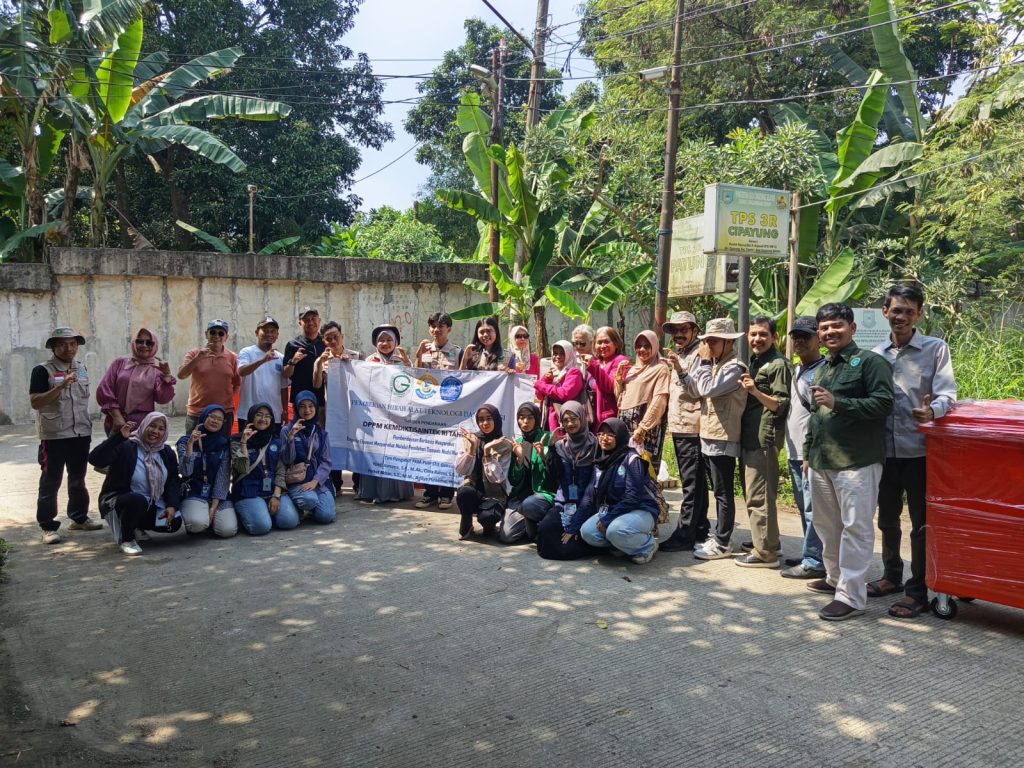
South Tangerang, August 3, 2025 — The Community Service Team of STIE Ganesha successfully held a workshop with the theme “Community Economic Empowerment through Waste Sorting: A Community-Based Management Model” at the Payung Mas Village Hall, RW 12, Cipayung Subdistrict, Ciputat, South Tangerang. It took place on Wednesday (3/8) and was enthusiastically attended by dozens of residents.
The workshop was motivated by the increasingly complex waste problems in South Tangerang, particularly in Ciputat. Waste not only creates environmental issues but also holds economic potential that has long remained untapped. Through a community-based management approach, the service team—comprising Yandi Asmana, Cinta Rahmi, and Farhat Abas—encouraged residents to shift their mindset that waste is not merely trash, but a resource with market value.
In his remarks, the Secretary of Cipayung Subdistrict expressed his appreciation for this initiative. “We hope the methods and innovations presented can be implemented in waste management at TPS3R RW 12, and eventually across the entire Cipayung Subdistrict,” he said.
According to data from the South Tangerang Environmental Agency, each person produces around 0,74 kg of waste per day. With a population of 27.631, Cipayung Subdistrict generates a total of 20,4 tons of waste daily. This figure highlights the vast potential that can be utilized to boost household income.
The workshop was not limited to lectures but also featured hands-on practice. Participants learned household waste sorting techniques, waste bank management, and value creation education, including making handicrafts from recycled materials and processing organic waste into compost with economic value. During the practical session, residents were taught simple methods to transform wet or organic waste into compost that could be used for home gardening or sold as an additional source of income.
As a form of concrete support, the STIE Ganesha team also provided three large 660-liter trash bins, strategically placed in the neighborhood. In addition, residents received a composting machine (Composter IT), which accelerates the decomposition process to produce high-quality compost in a shorter time.
One of the participants, Mrs. Agustin, a member of the Women Farmers Group (Kelompok Wanita Tani/KWT), said she gained valuable new insights. “All this time, we only collected and burned waste. After this training, we learned that even used shampoo bottles can be saved and turned into money. Plus, making compost is surprisingly easy. We are very excited to start applying this knowledge and to establish a waste bank in our neighborhood,” she said enthusiastically.
Other members of the KWT community who attended were equally enthusiastic. They expressed hopes that similar community service activities could also be held in their respective neighborhoods, especially in areas that need assistance in managing waste and turning it into income-generating opportunities.
As part of the implementation of the Tri Dharma of Higher Education, the STIE Ganesha service team reaffirmed its commitment to provide continuous mentoring. “We hope that, in the future, the community waste bank at TPS3R RW 12 will already be able to provide real economic benefits for residents,” explained the team coordinator.
Through this program, it is expected that the people of Cipayung will enjoy a cleaner and healthier environment, while also achieving economic independence rooted in environmental sustainability.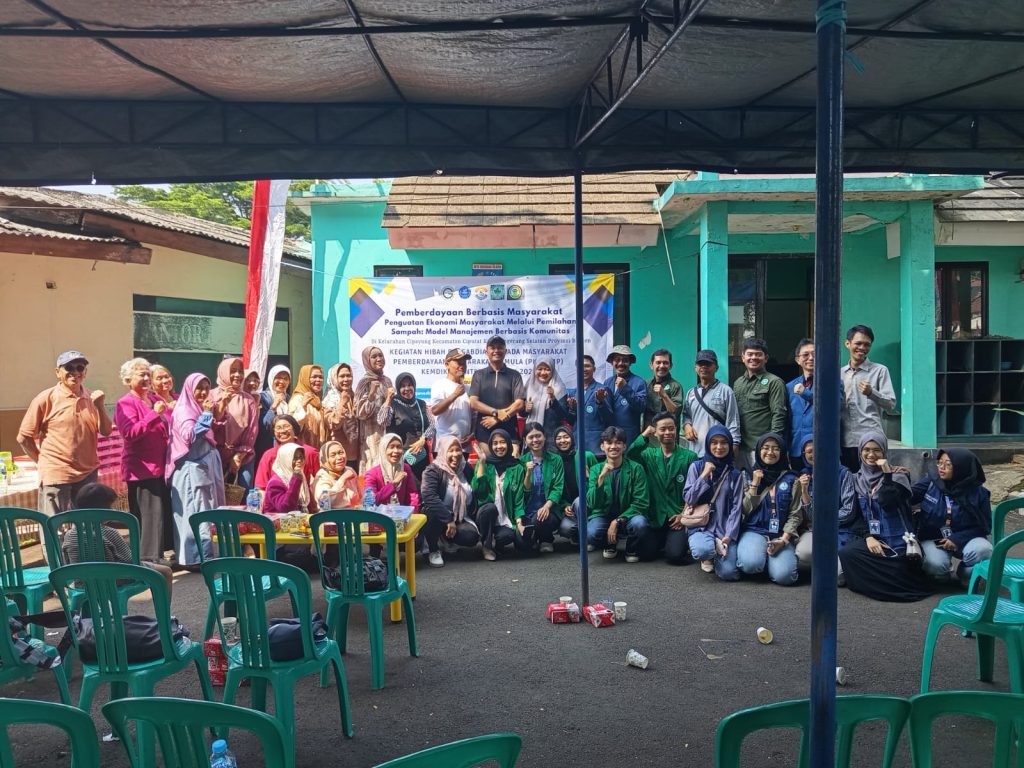 This community service initiative was funded by the “Hibah Pengabdian Masyarakat Pemula” (Beginner Community Service Grant) from the Directorate of Research and Community Service, Directorate General of Research and Development, Ministry of Education, Culture, Research, and Technology of the Republic of Indonesia for the 2025 fiscal year.
Through this program, it is expected that the people of Cipayung will enjoy a cleaner and healthier environment, while also achieving economic independence rooted in environmental sustainability.