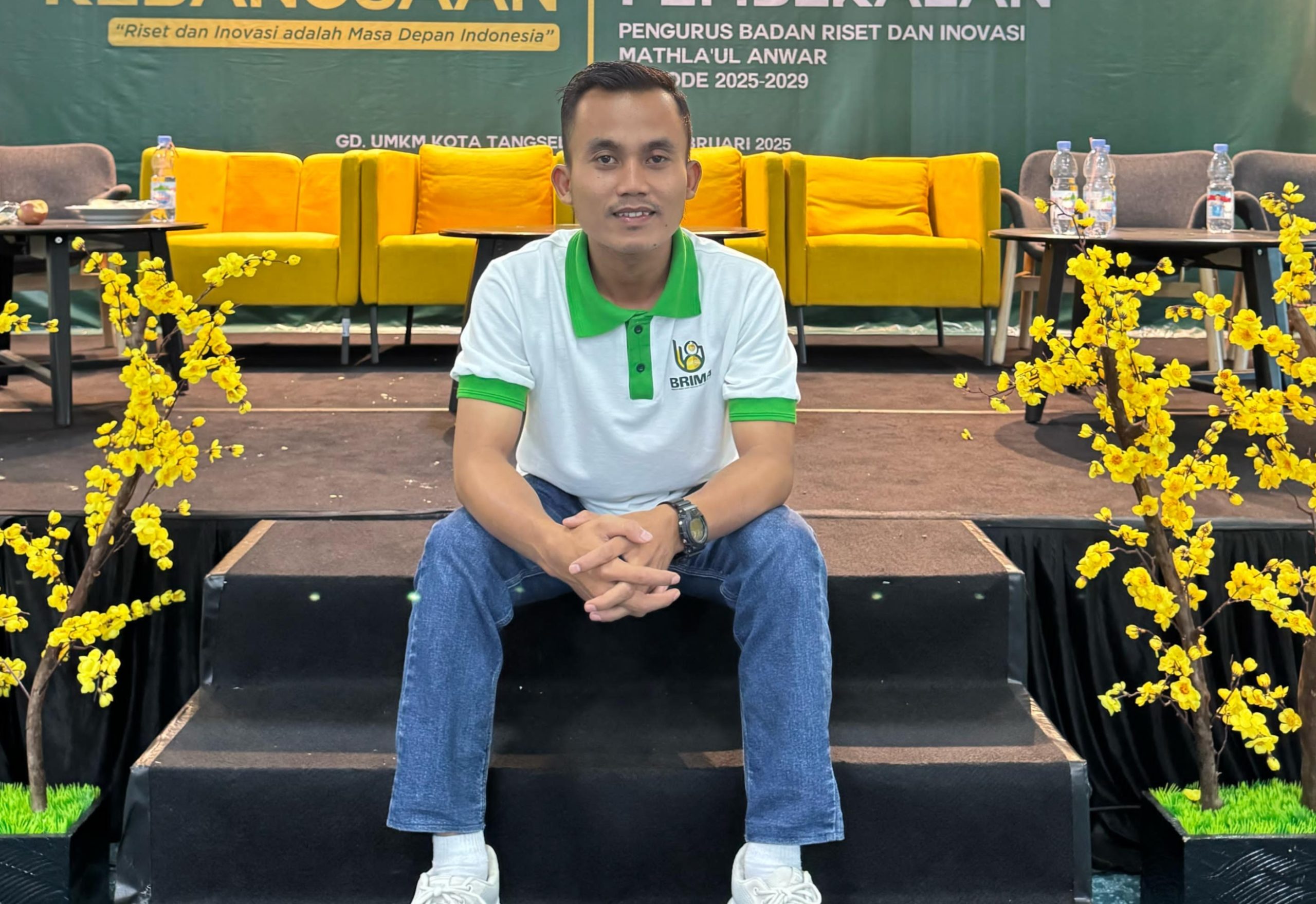
Thebantenpost.com. This article was born out of joy and deep affection as I welcome the 21st Congress (Muktamar) of Mathla’ul Anwar. I was raised within the ideological and educational environment of Mathla’ul Anwar. From Madrasah Ibtidaiyah (MI), Madrasah Tsanawiyah (MTs), to Madrasah Aliyah (MA), I grew up under its institutional guidance. The Islamic values, intellectual commitments, and social devotion that I uphold today cannot be separated from the long process of formation within this organization. Even today, I remain actively involved in the leadership of the Regional Board (DPD) of the Himpunan Mahasiswa Mathla’ul Anwar (HIMMA) in Lebak. Therefore, this reflection emerges internally—from a cadre who sincerely wishes to see his organization move further forward.
On April 11–13, 2026, in Serang City, Banten, the extended family of Mathla’ul Anwar will convene its 21st Congress alongside the 6th National Conference of Muslimat Mathla’ul Anwar (MUSMA). For me personally, this routine agenda is not merely a leadership succession forum. It is a highly strategic momentum to determine the organization’s direction amid increasingly dynamic social, political, and global transformations.
Islamic Organizations and Global Challenges
In the sociology of religion, religious organizations are not understood merely as institutions of preaching or education. They are also essential components of civil society that mediate between the state and society. At this point, religion plays a strategic social function: it provides values, moral frameworks, and ethical orientations in public life. Religion does not merely regulate the relationship between humans and God; it also offers direction for a nation’s collective life.
The sociologist of religion Robert N. Bellah emphasized the importance of religion in public spaces through his concept of civil religion. According to Bellah, national life always contains shared moral values rooted in religious traditions—such as justice, responsibility, sacrifice, and commitment to the common good. This means religion should not remain confined to the private sphere but must contribute positively and concretely to public life.
This perspective was further enriched by Jürgen Habermas through his idea of the post-secular society. Habermas argued that modernity does not automatically eliminate the role of religion. In plural and complex societies, religion remains necessary within public discourse. However, to be accepted in rational and democratic public spaces, religious values must be translated into universal and argumentative language. In other words, religious values must be communicated as inclusive human values.
Mathla’ul Anwar has significant potential to expand its role—not only locally and nationally, but also internationally. As an Islamic organization rooted in educational and da‘wah traditions, it possesses strong social capital, institutional networks, and intellectual heritage. These assets can be developed into moral forces contributing to national and global issues.
At the national level, Mathla’ul Anwar can strengthen its role in education, social advocacy, human rights, religious moderation, and the reinforcement of national values. It can serve as a bridge between the aspirations of the Muslim community and state policies, while also acting as a constructive counterbalance in socio-political dynamics. Through a moderate and solution-oriented approach, it can demonstrate that Islam is not merely normative, but also constructive in addressing contemporary challenges.
Globally, this role can be expanded through religious diplomacy and international networking. Many Islamic organizations worldwide actively participate in global forums, including those under the auspices of the United Nations (UN), particularly in education, tolerance, peacebuilding, human rights, and sustainable development. Engagement in interfaith dialogue, international Islamic education conferences, and global peace forums would strengthen Mathla’ul Anwar’s position in the international arena.
Therefore, Mathla’ul Anwar needs to systematically build religious diplomacy, expand cross-border cooperation, and promote a moderate, adaptive, and globally relevant Islamic vision. Strengthening human resources—particularly in foreign language mastery, global literacy, and diplomatic skills—is an essential step forward.
National Role: Critical and Constructive Partnership
At the national level, religious organizations hold a strategic position as both partners of the state and moral forces within society. They serve not only as agents of da‘wah, education, and social service but also as constructive social controllers. In Islamic tradition, this function is normatively grounded in the concept of amar ma‘ruf nahi munkar (enjoining good and forbidding evil).
In modern nation-state contexts, this mandate can be interpreted as a moral obligation to engage in public policy advocacy, political education of the community, strengthening social ethics, and providing social services without discrimination based on race, ethnicity, or religion. Being critical means courageously offering input, correction, and even firm criticism toward unjust policies. Being constructive means maintaining stability and unity while offering real solutions to national problems.
The theory of elite circulation proposed by Vilfredo Pareto reminds us that every organization or social system inevitably undergoes leadership change. If regeneration functions healthily, the organization remains dynamic and adaptive. Without elite renewal, however, stagnation and exclusivity become unavoidable.
Thus, future leadership within Mathla’ul Anwar—especially its Chairman—must possess not only administrative competence but also broad national vision, socio-political awareness, and the ability to bridge community aspirations with state policies. Leadership must be visionary, networked across civil society organizations, religious leaders, academics, and policymakers.
Regeneration: Investment Toward Indonesia Emas 2045
Mathla’ul Anwar’s autonomous bodies—including HIMMA, Generasi Muda Mathla’ul Anwar (GEMA MA), Ikatan Pelajar Mathla’ul Anwar (IPMA), and Muslimat Mathla’ul Anwar (MUSMA)—are the most strategic arenas of regeneration. From a human resource development perspective, investing in youth is the primary foundation for achieving Indonesia Emas 2045, as emphasized in national demographic planning documents.
Indonesia Emas 2045 is not a distant abstraction. It is only nineteen years away. Demographically speaking, those who will be in their productive years (25–55) in 2045 are those currently aged approximately 6–36. This means today’s schoolchildren, students, and young organizational cadres are the main actors of Indonesia Emas.
Within Mathla’ul Anwar, this reality is both an alarm and an opportunity. The current members of IPMA, GEMA MA, and especially HIMMA will become future leaders, policymakers, academics, professionals, and community figures in 2045.
If cadre formation proceeds superficially today, a leadership crisis may emerge two decades from now. However, if regeneration is designed seriously, systematically, and sustainably, Mathla’ul Anwar will cultivate elites who are intellectually mature, spiritually grounded, and organizationally competent.
Indonesia is projected to experience a demographic bonus between 2030 and 2045. Yet a demographic bonus is not automatically a blessing; it can become a burden if the generation lacks competence and character.
HIMMA is not merely a complementary student organization; it is a leadership laboratory. Therefore, future central leadership must:
1. Design a tiered and sustainable cadre system.
2. Encourage economic independence among cadres as a foundation of organizational strength.
3. Provide genuine spaces for youth actualization within Mathla’ul Anwar.
Without intellectually excellent, spiritually mature, organizationally strong, and financially independent cadres, it is difficult to imagine Mathla’ul Anwar surviving within increasingly complex social competition.
Thus, the 21st Congress is not merely about who will be elected, but about how the organization’s grand vision will be formulated. The leadership emerging from this forum must integrate three main agendas:
1. Strengthening national roles.
2. Expanding international networks.
3. Consolidating regeneration through HIMMA and all autonomous bodies.
If these agendas are implemented simultaneously, Mathla’ul Anwar will emerge not merely as a historical organization, but as a moral-intellectual force relevant to the times. The 21st Congress and the 6th National Conference of Muslimat Mathla’ul Anwar are a historical calling, demanding intellectual maturity, clarity of vision, and strategic courage.
Ultimately, with visionary leadership and strong regeneration, Mathla’ul Anwar can move forward toward significant national roles and meaningful international contributions.
By: Aceng Murtado
(Alumnus of Mathla’ul Anwar Cikeusik from MI to MA, and Executive Board Member of the Regional Himpunan Mahasiswa Mathla’ul Anwar, Lebak)